ORGANIC CARE · MADE IN FRANCE · CARIBBEAN INSPIRED
Hair porosity: understanding and analysing your fiber
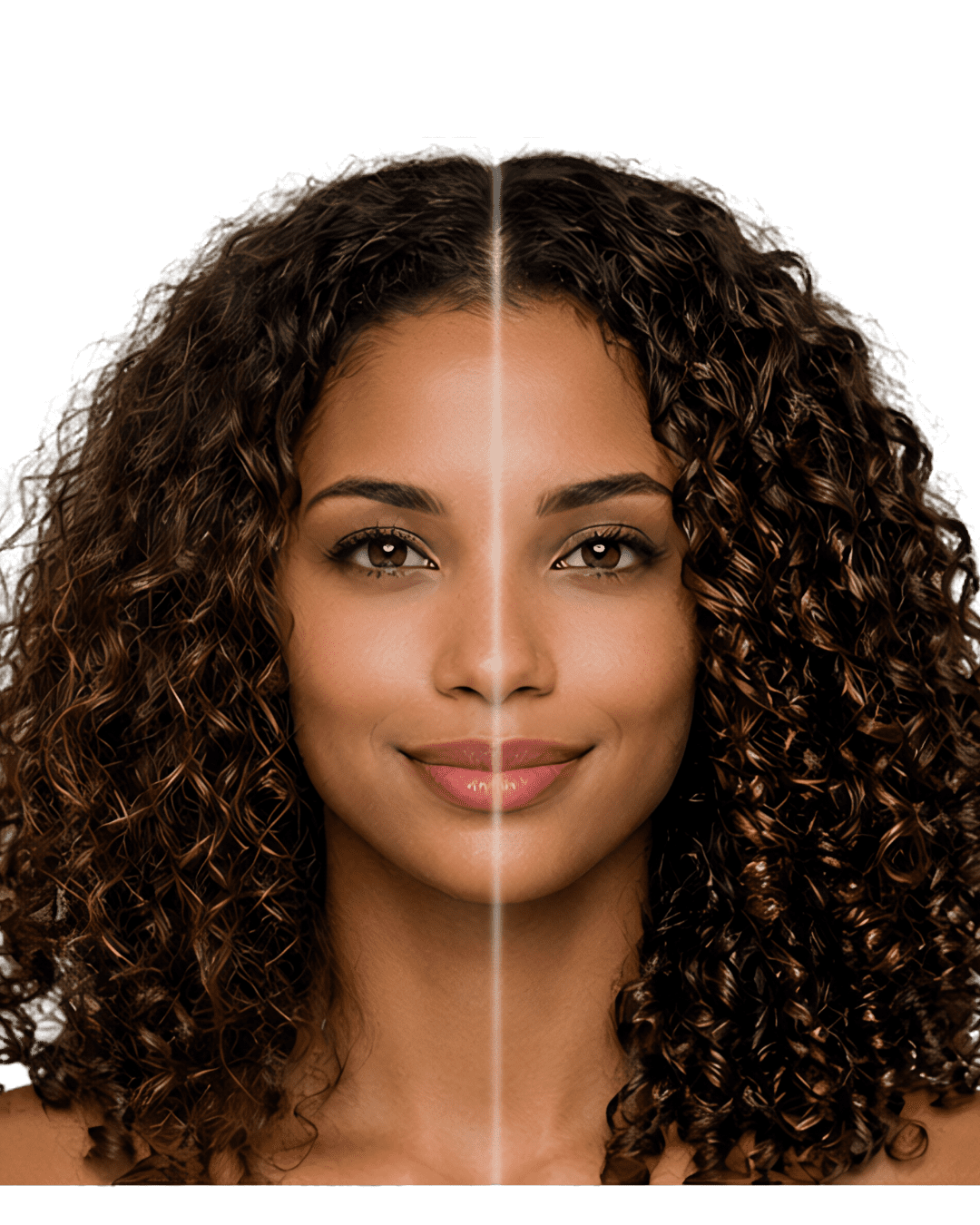
HAIR PORES: UNDERSTANDING THE FIBER TO BETTER TREAT IT
La Hair porosity is an essential element for understanding How your hair absorbs and retains moisture. It determines how the fiber reacts to care products, water, and external aggressions. For textured hair, knowing its hair porosity is the key to an effective and personalized routine.
When the cuticles are tightened, The water diffuses easily but remains for a long time. When they are Open, The water gets in quickly… but it also gets out just as quickly.
Understanding its porosity is to understand it How to hydrate effectively her hair.
What is capillary porosity?
Capillary porosity corresponds to the ability of the hair to absorb and hold back hydration. It depends on the state of the cuticles, These are small protective scales that cover the fiber.
Cuticles tightened → the water penetrates with difficulty but remains for a long time.
Cuticles Open → the water moves quickly but escapes quickly.
Understanding hair porosity allows you to adapt your routine to the real biology of the hair.
Pipeska — the expert native of textured hair.
Hydration vs Nutrition — to explain how porosity influences needs.
Why is capillary porosity essential for textured hair?
Textured hair naturally has:
a cuticle less regular,
a fiber more sensitive to drought,
hydration more difficult to maintain.
Two identical hairs can react differently to the same care product: hair porosity explains these variations.
The three levels of hair porosity

Poor hair porosity
Very tight cuticles. Durable hydration
Shiny hair
The water is difficult to penetrate
Recommended routine:
Ocean Clean shampoo
Mild warmth to slightly open the cuticles
Explore Hydra‑Marin shampoo to hydrate gently
Average porosity
Aligned cuticles, slightly open. Perfect balance, flexibility, easy hydration
Recommended routine: Hydra‑Marin · Caribbean Fusion. Hair Mask · Universal Conditioner
Try it Caribbean Fusion for balanced hydration with aloe vera.
High porosity
Very open cuticles, Dryness, Frizzy hair, Split ends
Recommended routine: Ocean Clean · Caribbean Fusion. Long-lasting mask · Universal balm to seal in moisture.
Discover Capillary Repairing Mask with Lingzhi to strengthen the fiber. Science of textured hair — to deepen the biology of the cuticle.
How to test your Hair porosity ?
* Water glass test
Place a clean hair in a glass of water.
It floats → low porosity
It flows slowly → average porosity
It flows quickly → high porosity
* Touch test
Move your fingers from bottom to top.
Smooth surface → low
Lightly textured surface → medium
Rough surface → high
* Test of the drying time
Slow drying → low
Normal drying → average
Very rapid drying → high
The Pipeska approach: gentle science & effectiveness
At Pipeska, each formula is designed to respect the nature of textured hair:
clean without stripping off the paint
hydrating without weighing you down
Repair without suffocating
Seal without hardening
A scientific, natural, sensory approach. Authentic beauty revealed in a gentle way.
Pipeska — the expert native of textured hair. About Pipeska —
Scientific references
To guarantee the quality and rigor of our content, Pipeska relies on scientific sources recognized in the study of hair fiber, the structure of the hair, and the mechanisms of hydration.
Scientific measurement of capillary porosity
A study published on PubMed proposes an innovative method for measuring the Hair porosity using gas sorption. This technique allows the quantification of the volume of pores, their distribution and the damaged surface of the hair. The results show that chemical damage (such as oxidation) and UV damage modify the porosity through different mechanisms, confirming the central role of the hair’s internal structure in its ability to absorb and retain hydration. Source: PubMed study on capillary porosity
Going further
Ocean Clean shampoo— to purify without stripping the cuticle.
The Universal Baume — to seal the hydration according to the level of porosity.
- Hydra‑Marin shampoo — to deeply hydrate depending on the porosity.
- The Hair Mask Repairer — to strengthen the fiber and smooth the cuticles.